A high risk eCommerce payment solution with USDT payouts solves the single biggest problem online merchants face: getting banned by Stripe or PayPal while losing revenue to chargebacks. A high risk eCommerce payment solution built on card-to-crypto technology lets you accept credit cards, Apple Pay, Google Pay, and other popular methods — then settle instantly in USDT directly to your crypto wallet, bypassing banks entirely. Understanding how high risk ecommerce payment solution works helps readers make smarter decisions.
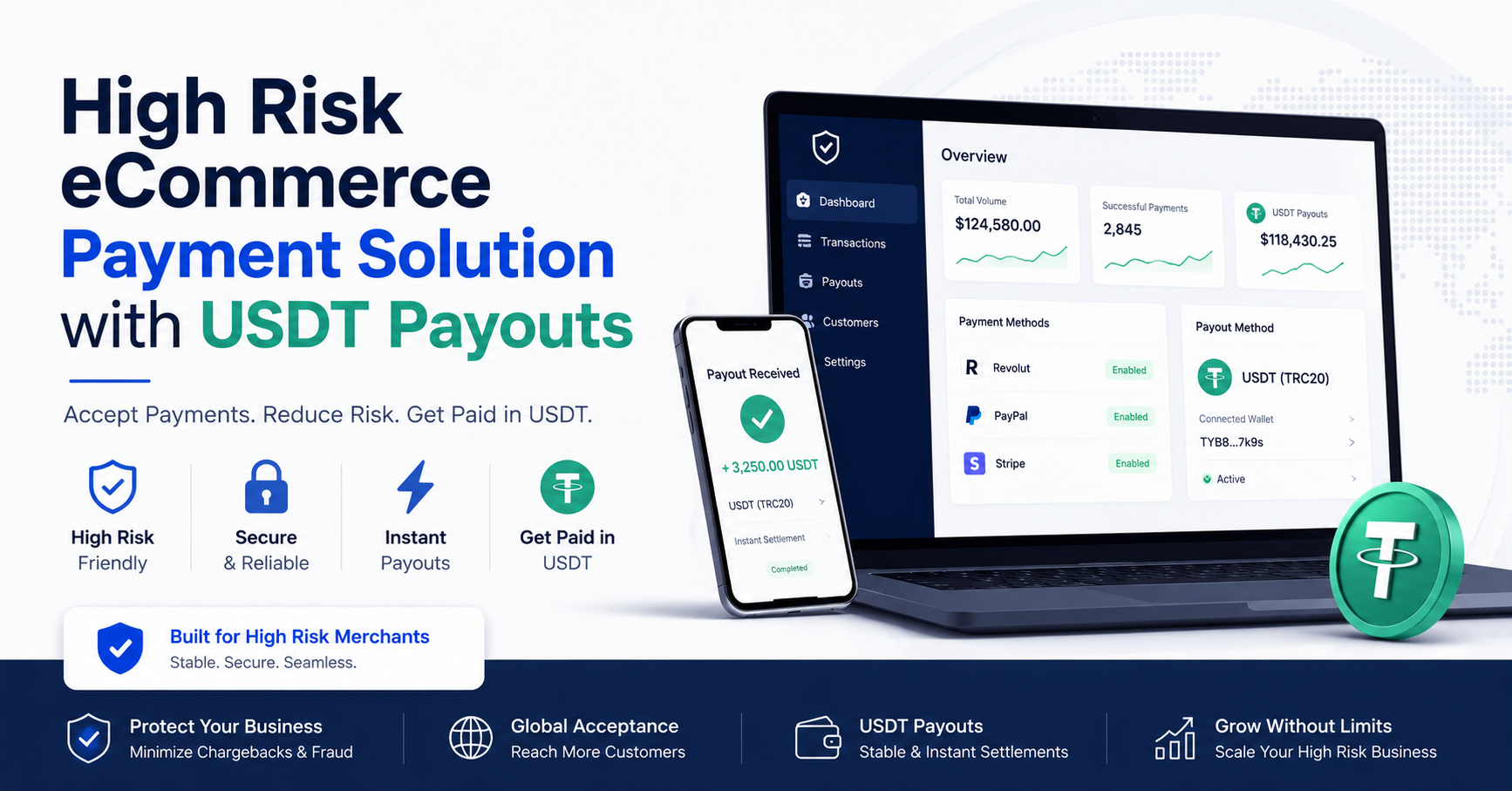
- High risk merchants can accept cards and settle in USDT without a bank account or business registration.
- Card-to-crypto gateways eliminate chargebacks because crypto transactions are irreversible by design.
- WcPay supports credit cards, Apple Pay, Google Pay, PayPal, Revolut, Binance Pay, Interac, and UPI in one plugin.
- Setup takes under 60 seconds — you only need a WooCommerce site and a USDT wallet such as Trust Wallet.
- No LLC, no KYC, and no monthly fees are required to start accepting payments.
- USDT payouts are instant, stable, and not subject to 180-day holds or account freezes.
- Choose a gateway that settles in USDT to remove chargeback risk from your business model permanently.
- Verify that the plugin supports your specific high risk niche before purchasing any solution.
- Instant crypto payouts protect your cash flow from payment processor holds and sudden account bans.
- A single WooCommerce plugin can replace multiple payment processors and reduce operational complexity.
- You do not need a company registration or KYC documents to start processing payments with WcPay.
- Always keep a USDT wallet address ready before activating any card-to-crypto gateway.
- What Makes a Payment Solution “High Risk” in eCommerce?
- Why USDT Payouts Are the Smartest Settlement Method
- How a High Risk eCommerce Payment Solution Works Step by Step
- Key Features to Demand From Any High Risk Gateway
- WcPay: A High Risk eCommerce Payment Solution Built for WooCommerce
- Comparison: Card-to-Crypto vs Traditional High Risk Merchant Accounts
- Common Mistakes High Risk Merchants Make When Choosing a Gateway
- Frequently Asked Questions
What Makes a Payment Solution “High Risk” in eCommerce?
A high risk eCommerce payment solution is designed for businesses that standard processors like Stripe and PayPal routinely decline or ban. Industries classified as high risk include supplements, IPTV, adult content, CBD, forex, gambling, dropshipping, and digital products with high refund rates. Comparing high risk ecommerce payment solution options is the first step to finding the best value.
Traditional processors flag these merchants because they carry elevated chargeback ratios, regulatory complexity, or reputational concerns. Once flagged, accounts are frozen, funds held for months, and the merchant is left with no way to collect revenue. Many readers search for high risk ecommerce payment solution before making their first purchase.
Understanding what triggers a high risk classification helps you choose the right infrastructure from day one. Key triggers include: The right high risk ecommerce payment solution platform saves time and reduces frustration.
- Chargeback ratios above typical thresholds set by card networks
- Selling in industries with heavy regulatory scrutiny
- Operating internationally across multiple jurisdictions
- Selling subscription-based or recurring billing products
- Lacking a formal business registration or LLC
Why USDT Payouts Are the Smartest Settlement Method
USDT (Tether) payouts give high risk merchants instant, stable access to their funds without relying on a bank account. Because USDT is pegged to the US dollar, merchants avoid the price volatility associated with Bitcoin or Ethereum while still benefiting from blockchain’s irreversibility. Experienced buyers know that high risk ecommerce payment solution quality varies by platform.
When a customer pays by card, the gateway converts the fiat payment and routes the equivalent USDT directly to your wallet. This process removes the acquiring bank from the equation, which is precisely where chargebacks originate. Finding a reliable high risk ecommerce payment solution source is easier than most people expect.
According to the Wikipedia article on chargebacks, a chargeback is a forced reversal initiated by the cardholder’s bank — a mechanism that does not exist in blockchain transactions. Once USDT lands in your wallet, no third party can reverse it. The best high risk ecommerce payment solution services prioritize instant delivery and clear pricing.
Additional advantages of USDT settlement include: Checking reviews before choosing a high risk ecommerce payment solution provider is always recommended.
- No 180-day payment holds like those imposed by PayPal on high risk accounts
- No currency conversion fees when trading internationally
- Funds accessible immediately, not after a multi-day bank clearing cycle
- Compatible with major wallets including Trust Wallet and MetaMask
For a deeper look at how this model protects your revenue, see why crypto payout gateways have zero chargebacks and why it matters.
How a High Risk eCommerce Payment Solution Works Step by Step
A high risk eCommerce payment solution using card-to-crypto technology follows a straightforward flow that most merchants can activate in under one minute. The customer experience at checkout looks identical to any standard payment form, which preserves conversion rates.
This architecture is what makes a high risk eCommerce payment solution fundamentally different from a standard merchant account. The settlement layer is entirely decentralized, which removes the institutional chokepoints that cause account bans and fund freezes.
Key Features to Demand From Any High Risk Gateway
Not every gateway marketed to high risk merchants delivers equal protection or capability. A reliable high risk eCommerce payment solution must meet a strict set of criteria before you trust it with your store’s revenue.
Evaluate every candidate against this checklist:
- Instant USDT or stablecoin payouts — delays of 24 to 72 hours defeat the purpose of crypto settlement
- No chargeback exposure — confirm the settlement model is truly card-to-crypto, not a traditional acquiring arrangement
- Multi-method checkout — cards alone are insufficient; Apple Pay, Google Pay, and local methods like Interac or UPI drive significant conversion
- No KYC or business registration requirement — essential for sole traders and international merchants without an LLC
- WooCommerce-native plugin — avoid redirect-based solutions that increase cart abandonment
- Lifetime updates and dedicated support — high risk niches face evolving compliance requirements
- Zero monthly fees — flat per-transaction models are more predictable for scaling stores
You can also review which payment gateways approve high risk merchants instantly to compare options across these criteria.
WcPay: A High Risk eCommerce Payment Solution Built for WooCommerce
WcPay is a high risk eCommerce payment solution engineered specifically for WooCommerce stores that have been rejected or banned by conventional processors. It operates as a card-to-crypto gateway, meaning customers pay in fiat and merchants receive USDT instantly.
The plugin integrates natively into the WooCommerce checkout without redirecting customers to an external page. This matters because redirects consistently reduce conversion rates, especially on mobile devices.
WcPay supports the following payment methods out of the box:
- Credit and debit cards (Visa, Mastercard, and others)
- Apple Pay and Google Pay
- PayPal, Revolut Pay, and Binance Pay
- Interac (for Canadian merchants)
- UPI (for Indian and South Asian customers)
- Major local payment methods across 150+ countries
After ordering from wcpay.us, merchants receive the WcPay plugin, an activation serial key, a full installation guide, and free lifetime updates. The entire setup process takes under 60 seconds from plugin install to first live transaction.
Importantly, WcPay requires no company registration, no LLC, and no KYC documents. All you need is a professional WooCommerce website and a USDT wallet address. This makes it accessible to freelancers, sole traders, and international merchants who cannot or prefer not to register a formal business entity.
For merchants who have experienced account freezes, see what happens when Stripe or PayPal bans your account and what to do next.
Comparison: Card-to-Crypto vs Traditional High Risk Merchant Accounts
Understanding the structural differences between these two models helps merchants make an informed decision rather than defaulting to whichever solution appears first in a search result.
| Feature | Card-to-Crypto (WcPay) | Traditional High Risk Merchant Account |
|---|---|---|
| Settlement currency | USDT (instant) | USD/EUR (2-7 business days) |
| Chargeback exposure | Zero — crypto is irreversible | Full exposure, reserve accounts common |
| KYC requirement | None required | Full KYC and business documents |
| LLC or company required | No | Usually yes |
| Account ban risk | None — no bank dependency | High — processor can terminate anytime |
| Monthly fees | None | Often USD 50 to USD 500+ |
| Setup time | Under 60 seconds | Days to weeks for underwriting |
| Payment methods | Cards, Apple Pay, Google Pay, PayPal, Revolut, Binance, Interac, UPI | Cards only in most cases |
| Fund holds | None | Rolling reserves of 5-15% common |
The card-to-crypto model wins decisively on speed, accessibility, and chargeback protection. Traditional high risk merchant accounts still make sense for merchants who specifically need fiat settlement and have the documentation to pass underwriting — but for most WooCommerce store owners, the card-to-crypto approach is structurally superior.
For a detailed breakdown, read Card2Crypto vs traditional merchant account: which is better for you.
The broader shift toward stablecoin settlement is also documented by financial researchers. The Wikipedia entry on Tether (USDT) explains how USDT maintains its dollar peg and why it has become the dominant stablecoin for merchant settlement globally.
Common Mistakes High Risk Merchants Make When Choosing a Gateway
A high risk eCommerce payment solution is only as good as the merchant’s implementation decisions. Several avoidable errors repeatedly cause merchants to lose revenue even after switching to a crypto-based gateway.
Mistake 1: Choosing a redirect-based checkout. Any solution that sends customers to an external payment page increases cart abandonment. Always confirm the plugin processes payments natively within WooCommerce checkout.
Mistake 2: Ignoring wallet security. USDT payouts land directly in your wallet. If your wallet is compromised, funds cannot be recovered. Use a hardware wallet or a well-audited software wallet like Trust Wallet for large balances.
Mistake 3: Not verifying niche compatibility. Some gateways advertise high risk support but exclude specific industries in their terms of service. Confirm your niche is explicitly supported before purchasing.
Mistake 4: Underestimating conversion impact of payment methods. Offering only card payments on a mobile-heavy audience misses Apple Pay and Google Pay users who convert at significantly higher rates. Ensure your chosen solution includes both.
Mistake 5: Delaying the switch after a first ban. Merchants who receive a first warning from Stripe or PayPal often wait until a full ban and fund freeze before acting. Switching to a high risk eCommerce payment solution proactively protects revenue continuity.
For merchants running subscription models, this guide on payment gateways for subscription services flagged as high risk covers additional considerations specific to recurring billing.
Frequently Asked Questions
What is a high risk eCommerce payment solution?
A high risk eCommerce payment solution is a payment processing system designed for merchants in industries that standard processors decline, such as supplements, adult content, IPTV, CBD, and forex. These solutions use alternative acquiring infrastructure and often settle in cryptocurrency like USDT to avoid chargebacks and bank-imposed restrictions.
How do USDT payouts eliminate chargebacks?
USDT payouts eliminate chargebacks because blockchain transactions are irreversible by design. Once a customer’s card payment is converted to USDT and sent to your wallet, no bank or card network can initiate a reversal. This is structurally different from fiat settlements, where cardholders can dispute transactions for up to 120 days after purchase.
Do I need an LLC or business registration to use WcPay?
No. WcPay does not require an LLC, Ltd, or any formal business registration. You only need a professional WooCommerce website and a USDT wallet address such as Trust Wallet. This makes WcPay accessible to freelancers, sole traders, and international merchants who operate without a registered company entity.
Which payment methods does WcPay support?
WcPay supports credit and debit cards, Apple Pay, Google Pay, PayPal, Revolut Pay, Binance Pay, Interac, and UPI, along with major local payment methods across more than 150 countries. All methods are natively integrated into the WooCommerce checkout without redirecting customers to an external page.
How long does setup take for a high risk eCommerce payment solution?
WcPay setup takes under 60 seconds from plugin installation to processing live transactions. After ordering from wcpay.us, you receive the plugin file, an activation serial key, and a full installation guide. No underwriting review or lengthy approval process is required, unlike traditional high risk merchant accounts.
Can I use WcPay if Stripe or PayPal already banned my account?
Yes. WcPay operates entirely independently of Stripe and PayPal’s infrastructure. A ban or suspension from either processor has no effect on your ability to use WcPay. Because settlement occurs in USDT directly to your crypto wallet, there is no shared acquiring relationship that a previous ban could affect.
Is there a monthly fee for using a card-to-crypto gateway?
WcPay charges no monthly fees. The cost structure is based on a one-time plugin purchase, which includes free lifetime updates. This is significantly more cost-effective than traditional high risk merchant accounts, which typically charge monthly fees ranging from tens to hundreds of dollars in addition to per-transaction rates.
What wallet do I need to receive USDT payouts?
Any USDT-compatible wallet works, including Trust Wallet, MetaMask, and most major software and hardware wallets. WcPay sends payouts to the USDT wallet address you configure in the plugin settings. Trust Wallet is commonly recommended for beginners because it supports USDT on multiple blockchain networks and has a straightforward mobile interface.
A high risk eCommerce payment solution with USDT payouts is no longer a niche workaround — it is the most reliable infrastructure available for merchants who need to keep selling without fear of sudden bans, fund holds, or chargeback losses. WcPay delivers all of this in a single WooCommerce plugin that activates in under a minute. To get started and protect your store’s revenue today, visit the complete setup guide for instant USDT payouts on WooCommerce and configure your gateway in the time it takes to read this conclusion.