To accept PayPal on WooCommerce and receive PYUSD stablecoin payouts, you need a card-to-crypto gateway that bridges PayPal’s buyer-facing checkout with a crypto wallet settlement layer — and WcPay does exactly that. Accept PayPal on WooCommerce without the usual restrictions, account bans, or 180-day holds by routing your settlements directly into a stablecoin wallet instead of a bank account. Understanding how accept paypal on woocommerce works helps readers make smarter decisions.
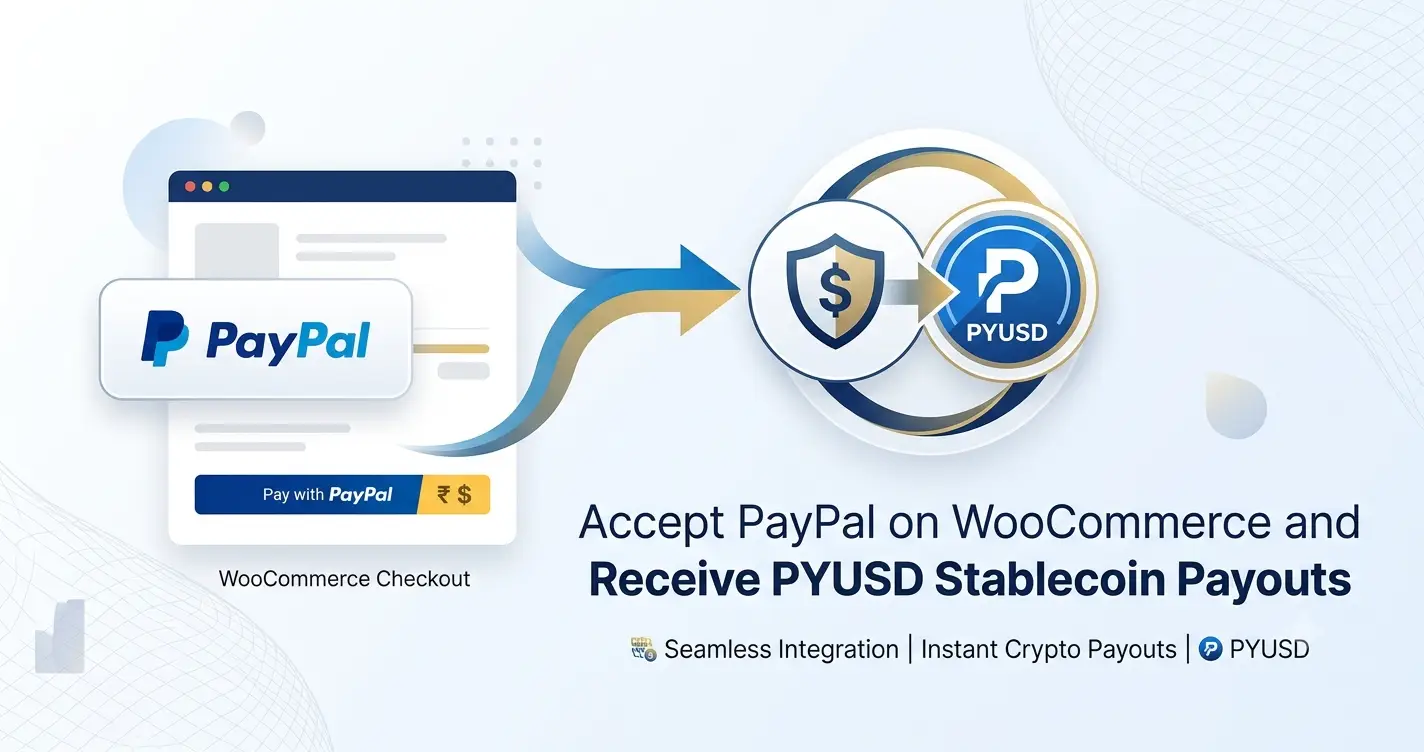
- WcPay lets WooCommerce stores accept PayPal payments and receive payouts in PYUSD or USDT stablecoins instantly.
- The card-to-crypto model eliminates chargebacks because crypto transactions are irreversible once confirmed.
- Setup takes under one minute — no LLC, no KYC, and no bank account required.
- PYUSD is PayPal’s own USD-pegged stablecoin, designed for fast, low-cost digital settlements.
- High-risk merchants benefit most: no account suspensions, no fund holds, no payment processor bans.
- You only need a WooCommerce website and a compatible crypto wallet to get started.
- Accepting PayPal on WooCommerce with stablecoin payouts removes the risk of PayPal freezing your funds.
- PYUSD is pegged 1:1 to the US dollar, so you receive stable value without crypto price volatility.
- WcPay supports PayPal, cards, Apple Pay, Google Pay, and Binance Pay — all in one plugin.
- Stablecoin settlements are final and irreversible, making chargebacks structurally impossible.
- No company registration or KYC documents are needed to activate WcPay on your WooCommerce store.
- Payouts land in your wallet within minutes of each completed customer transaction.
- What Is PYUSD and Why Does It Matter for WooCommerce Merchants?
- Why Accept PayPal on WooCommerce With Stablecoin Payouts Instead of Bank Transfers?
- How the Card-to-Crypto Model Works for PayPal Settlements
- 5 Steps to Accept PayPal on WooCommerce and Receive PYUSD Payouts
- Comparison: Traditional PayPal Payouts vs. PYUSD Stablecoin Payouts
- Who Should Use This Setup?
- Common Mistakes to Avoid When Setting Up PayPal Crypto Payouts
- Frequently Asked Questions
What Is PYUSD and Why Does It Matter for WooCommerce Merchants?
PYUSD is PayPal’s own USD-pegged stablecoin, issued on public blockchains and redeemable at a 1:1 ratio with the US dollar. Unlike volatile cryptocurrencies such as Bitcoin or Ethereum, PYUSD holds a stable value, which makes it practical for everyday merchant settlements. Comparing accept paypal on woocommerce options is the first step to finding the best value.
For WooCommerce store owners, this is significant. Receiving PYUSD means you get the speed and finality of crypto without the price swings. Your revenue stays predictable while you avoid the traditional banking rails that often freeze or delay merchant funds. Many readers search for accept paypal on woocommerce before making their first purchase.
Why Accept PayPal on WooCommerce With Stablecoin Payouts Instead of Bank Transfers?
When you accept PayPal on WooCommerce through a standard integration, your funds pass through PayPal’s internal holding system before reaching your bank — a process that can take days and is subject to sudden freezes, rolling reserves, or the notorious 180-day hold for high-risk accounts. The right accept paypal on woocommerce platform saves time and reduces frustration.
Stablecoin payouts bypass all of that. Once a customer completes a PayPal payment at checkout, the equivalent value is routed to your crypto wallet as PYUSD or USDT within minutes. There is no intermediary bank, no reserve requirement, and no risk of the payment processor reversing the settlement. Experienced buyers know that accept paypal on woocommerce quality varies by platform.
This model is especially powerful for merchants in high-risk niches — digital products, supplements, IPTV, adult content, dropshipping — where PayPal account suspensions are common. Learn more about how to protect your funds from PayPal’s 180-day hold and why stablecoin payouts are the cleanest solution available today. Finding a reliable accept paypal on woocommerce source is easier than most people expect.
How the Card-to-Crypto Model Works for PayPal Settlements
The card-to-crypto model is the architecture that makes it possible to accept PayPal on WooCommerce and receive stablecoin payouts without holding a traditional merchant account. The process is straightforward: your customer pays using PayPal (or a card, Apple Pay, or Google Pay), and you receive the equivalent in PYUSD or USDT directly to your wallet. The best accept paypal on woocommerce services prioritize instant delivery and clear pricing.
WcPay acts as the bridge. It integrates natively into your WooCommerce checkout, presents PayPal as a payment option to customers, and then converts the incoming payment into a stablecoin payout on the backend. The customer experience is identical to a standard PayPal checkout — the difference is entirely on the merchant’s settlement side. Checking reviews before choosing a accept paypal on woocommerce provider is always recommended.
Because the payout is a crypto transfer rather than a bank wire, it is irreversible. This is why the model produces zero chargebacks: once the stablecoin lands in your wallet, no customer, bank, or payment network can reverse it. Read the full explanation of why crypto payout gateways have zero chargebacks for a deeper technical breakdown.
5 Steps to Accept PayPal on WooCommerce and Receive PYUSD Payouts
Accepting PayPal on WooCommerce with PYUSD stablecoin payouts is a five-step process that takes less than a minute to complete once you have the WcPay plugin and your wallet address ready.
No company registration, no KYC documents, and no bank account are required at any stage. The entire setup is self-contained within your WooCommerce dashboard. For a detailed walkthrough, see the guide on how to get paid via PayPal and receive instant USDT payouts with WcPay.
Comparison: Traditional PayPal Payouts vs. PYUSD Stablecoin Payouts
Understanding the practical differences between standard PayPal bank transfers and PYUSD stablecoin payouts helps merchants make an informed decision about which settlement model fits their business.
| Feature | Traditional PayPal Bank Payout | PYUSD Stablecoin Payout via WcPay |
|---|---|---|
| Settlement Speed | 1 to 5 business days | Within minutes |
| Chargeback Risk | High — up to 180 days exposure | Zero — irreversible crypto transfer |
| Account Freeze Risk | High for high-risk niches | None — wallet-based settlement |
| Fund Hold Period | Up to 180 days for new or high-risk accounts | No hold — instant wallet delivery |
| KYC / Business Registration | Required | Not required with WcPay |
| Value Stability | USD (stable) | PYUSD pegged 1:1 to USD (stable) |
| High-Risk Merchant Support | Limited — frequent bans | Full support — no restrictions |
| Additional Payment Methods | PayPal only | Cards, Apple Pay, Google Pay, Binance Pay, Revolut Pay, Interac, UPI |
The comparison makes clear that PYUSD stablecoin payouts offer meaningful structural advantages for merchants who need reliability, speed, and protection from the payment processor ecosystem. You can also explore the full PayPal payment gateway with instant USDT payouts via WcPay for additional technical context.
Who Should Use This Setup?
Any WooCommerce merchant who wants to accept PayPal on WooCommerce without the risk of frozen funds or account bans will benefit from this setup. The PYUSD payout model is particularly well-suited for specific business profiles.
High-Risk Merchants in Restricted Niches
Merchants selling digital products, supplements, IPTV subscriptions, adult content, dropshipped goods, or forex-related services frequently face PayPal account suspensions under the standard integration. WcPay removes that risk entirely by decoupling the customer-facing PayPal checkout from the merchant’s settlement layer.
International Sellers Without a Local Bank Account
Merchants operating across borders often struggle to receive bank transfers in their home currency. A PYUSD stablecoin wallet accepts payouts from anywhere in the world, converts nothing, and requires no correspondent banking relationships. This is a practical solution for sellers in regions where traditional payment infrastructure is limited.
Freelancers and Sole Traders
WcPay does not require an LLC, Ltd, or any formal business registration. A freelancer with a WooCommerce site and a crypto wallet can accept PayPal on WooCommerce and receive PYUSD payouts on the same day they install the plugin. This is a genuine alternative to platforms like Gumroad or Sellix that impose their own restrictions.
To understand the full scope of who this solution serves, review how WcPay lets anyone accept payments without KYC or LLC.
Common Mistakes to Avoid When Setting Up PayPal Crypto Payouts
Even with a streamlined setup, merchants sometimes make configuration errors that delay their first payout or reduce checkout conversion rates. Avoiding these mistakes ensures your WooCommerce PayPal integration works correctly from day one.
- Using an incompatible wallet: PYUSD is issued on specific blockchain networks. Confirm your wallet (Trust Wallet or MetaMask are recommended) supports the correct network before pasting your address into WcPay settings.
- Leaving PayPal disabled in WooCommerce settings: WcPay adds the payment method, but you must also enable it under WooCommerce > Settings > Payments. Skipping this step means PayPal will not appear at checkout.
- Confusing PYUSD with USDT: Both are USD-pegged stablecoins, but they operate on different networks and have different liquidity profiles. WcPay supports USDT natively; PYUSD compatibility depends on your wallet and network configuration. Verify before going live.
- Not testing the checkout flow: Always complete a small test transaction after setup to confirm the payment method appears, processes correctly, and the payout reaches your wallet address.
- Ignoring the serial key activation step: The WcPay plugin requires an activation serial key to unlock full functionality. Skipping this step limits the gateway’s capabilities and may prevent PayPal from appearing as a checkout option.
For a broader look at how PayPal operates as a payment network and why its restrictions affect high-risk merchants, the context helps clarify why a stablecoin payout layer is a structural improvement rather than just a workaround.
Frequently Asked Questions
Can I accept PayPal on WooCommerce and receive payouts in PYUSD without a business account?
Yes. WcPay does not require a business PayPal account, an LLC, or any KYC documentation. You only need a WooCommerce website and a compatible crypto wallet. The plugin handles the PayPal checkout integration and routes your payouts directly to your wallet address as a stablecoin.
Is PYUSD the same as USDT?
No. PYUSD is PayPal’s proprietary USD-pegged stablecoin, while USDT is issued by Tether. Both maintain a 1:1 peg with the US dollar, but they are issued by different entities and operate on different blockchain networks. WcPay natively supports USDT payouts, and PYUSD compatibility depends on your wallet’s network support.
How fast do I receive my stablecoin payout after a customer pays via PayPal?
Payouts typically arrive in your wallet within minutes of a completed customer transaction. Unlike traditional PayPal bank transfers that take one to five business days, the crypto settlement layer processes transfers without banking intermediaries, which eliminates the delay entirely.
Will I still face chargebacks if I accept PayPal on WooCommerce through WcPay?
No. When you accept PayPal on WooCommerce through WcPay and settle in stablecoins, chargebacks become structurally impossible. Crypto transactions are irreversible once confirmed on the blockchain. There is no payment network that can force a reversal after the stablecoin has landed in your wallet.
Does WcPay support payment methods other than PayPal?
Yes. WcPay natively integrates credit and debit cards, Apple Pay, Google Pay, Revolut Pay, Binance Pay, Interac, and UPI — all within a single WooCommerce plugin. Every payment method settles to the same stablecoin wallet, giving you a unified payout destination regardless of how the customer chooses to pay.
Do I need to install multiple plugins to accept PayPal and get crypto payouts?
No. WcPay is a single plugin that handles both the customer-facing checkout (including PayPal) and the backend stablecoin payout routing. There is no need for a separate PayPal plugin, a separate crypto gateway, or any additional WooCommerce extensions to make the full setup work.
Is this setup legal for high-risk merchants?
Accepting payments via PayPal and settling in stablecoins is legal in most jurisdictions, provided your products and services are themselves legal. WcPay does not require KYC or business registration, but merchants remain responsible for complying with the laws of their own country regarding their specific products and tax obligations.
What crypto wallet should I use to receive PYUSD or USDT payouts?
Trust Wallet and MetaMask are the two most commonly used wallets with WcPay. Both support USDT on multiple networks including Ethereum and Tron. For PYUSD specifically, ensure your wallet supports the Ethereum network, as PYUSD is primarily issued there. Always verify the correct network before entering your wallet address in the plugin settings.
If you are ready to accept PayPal on WooCommerce and eliminate the risk of fund holds, chargebacks, and account suspensions, WcPay is the most direct path to stablecoin payouts without paperwork. Visit the WcPay PayPal payment gateway page to get the plugin, your activation key, and a full setup guide — and start receiving your first PYUSD payout within the hour.